An employee publication of the Texas Department of Criminal Justice
Winter 2026
Cutting-Edge Graphics
The Hobby and Torres Print Shops
The Texas Department of Criminal Justice (TDCJ), through Texas Correctional Industries, has three high-tech printing facilities located at the Hobby, Torres and Wynne units. They print business cards, brochures, pamphlets, letterhead stationery, calendars, generic business forms, books and manuals, parking tags and stickers, security decals and more. They offer all types of printing from black and white, multicolor, to full color in a variety of styles and sizes on many different mediums.
The print shops are equipped with the latest versions of computer design programs and can accept pre-formatted jobs electronically. Customers include city, county, state and federal agencies, public schools, public and private institutions of higher education, public hospitals and political subdivisions. The Torres Print Shop produces primarily black and white items for TDCJ and other state agencies.
Wynne Graphics has the capability to produce large items like foam core posters and pull-up banners. Wynne Graphics also produces business cards, lots and lots of business cards, note cards and envelopes, pharmacy certificates, banners, laminated window graphics and vehicle wraps. Wynne Graphics also prints official agency leadership portraits like those you see at all the administrative offices, district parole offices and units.
Hobby Print Shop
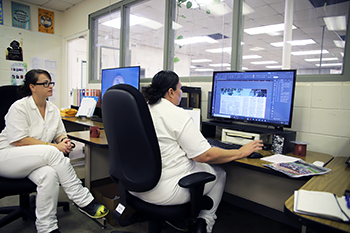
Candra Applegate watches as Susana Toledano works on the Summer 2025 issue of Connections.
Susana Toledano was 19 when she began her sentence in 2004. A native of Illinois, she moved to Texas when she was young to live with her grandmother and uncle. The most significant job she had ever held was in fast-food restaurants. Now she is the newest member of the “A-Team,” the group of six women of the pre-press department at the Hobby Unit. They do all the typesetting and graphic layout for Hobby Unit Print Shop color assignments.
For one of her first assignments, she was trained on Adobe InDesign by her mentor, Candra Applegate; they were busy working on the layout of the previous issue of Connections magazine, “Community.”
Toledano got her first job at the Hobby Print Shop in 2008 as a clerk in printing operations. She quickly became proficient running all the print shop machines, the presses, cutters, sorters and binders, when she caught the attention of assistant plant manager, Charles Beck. From his glass-walled office, he can see most everything happening on the production floor and get a good’s eye view of inmates working there who may be good candidates for pre-press. Toledano was one of those.
“Working in the Print Shop is the most adult job I’ve had. I like the stability, the routine. I know what to expect every day,” Toledano said. She is thankful that the pre-press unit took her under their wing.
Toledano said, “Before, if you asked me how to run a printer, I would tell you I don’t know how, and I don’t want to learn. Now, I work on a really big printer and I train people how to work on a really big printer! I am so thankful for these skills and for this opportunity.”
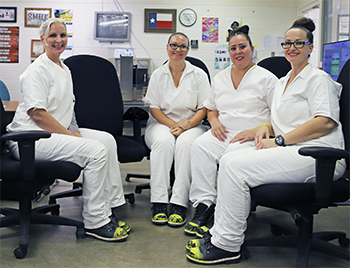
L to R: inmates Jenny Eisenman, Michelle Bearnth, Candra Applegate, and Susana Toledano.
In conjunction with the Windham School District, the A-Team also helps teach an apprenticeship class in graphic arts. Anyone on the unit can sign up for the class if they meet the qualifications.
“We set up the students on computers and pair everybody up. The students go through the book, and we teach them what we know. We help them with the book and assign them independent projects. The projects? We came up with them on our own,” Applegate said.
The class teaches students about color theory and how to recognize colors that do and don’t go together. They learn about spacing and margins and what will make a compelling product.
One of the projects the team works on are area high school football programs, and they take a lot of pride in their work.
“A lot of our heart goes into those football programs, because we design all those ads,” Applegate said.
The ads are spotlights of students and programs at the school. They are allowed to create portfolios of their work and send them home. Having a ready portfolio when they release can lead to good jobs in printing.
Working in the print shop gives the team an opportunity to mentor younger inmates.
“We get to teach them about a good work ethic,” Applegate said. “We teach them about time management, being responsible and being trustworthy.”
Toledano added, “When I’m mentoring someone new, I help them to be dependable and reliable, but also to have good sense an awareness, because safety precaution is a big deal. I want to know, ‘Are you willing to learn? Are you wanting to learn?’ There is a lot going on in here; there are all the machines and presses and all the different types of paper, and everything happens in a sequence.”
Toledano and Applegate never considered themselves to be creative, now they see a part of themselves they’ve never seen before.
“I’ve learned that that’s a part of myself that I’ve never seen before. It’s allowed me to open an outlet!” Applegate said. Toledano added, “I never knew I could be mechanically inclined. At my graduation, my grandmother and uncle got to come to the unit and see what I have been doing, and they were blown away!”
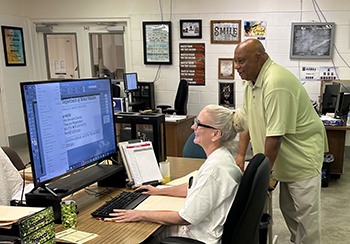
Charles Beck works with inmate Jenny Eisenman on a design project.
With years of work experience from printing and publishing companies behind him, Beck started working at the Hobby Unit in 2011. He transitioned quickly, working on a variety of printing equipment alongside inmate workers. One of those workers was Toledano.
“Toledano was a wild kid; she was in trouble all the time, but she was a good worker. I knew she was smart, because she was good on computers. She caught on pretty quick. The older she got, she started changing,” Beck said.
Toledano wanted to get into the design work, and when she finally got her chance, Beck said, “She’s a completely different person.”
Beck is driven by his spirituality. Over the years he has seen many women, such as Applegate and Toledano, change their behavior and their outlook on their lives. He sees himself as a role model and sets as best an example as he can.
He said, “I try not to miss work, and I am usually early for work (he arrives at the unit at 5:30 a.m.), because I want them to be like that when they get out: dependable, trustworthy and responsible.”
The women of the A-Team will tell you they love their jobs. They work as a team, they are driven to be creative, and they are continually challenged to produce and improve. They hope to continue this kind of work when they release to their communities.
“To me, that’s the best part of it. There are jobs out there that pay more, but this is rewarding really,” Beck said. “To see people change, see them get out of here and get good jobs and make good money. They call back a lot. They say, ‘Mr. Beck, I’m doing this and I’m doing that.’ Some of them ask for advice. It means a lot!”
Torres Print Shop
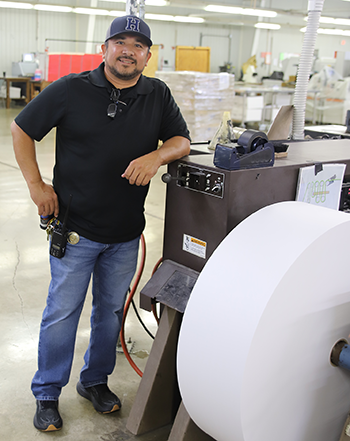
Hondo native, Chris Ybarra, Industrial Specialist IV.
While not quite as large as the Hobby Print Shop, the Torres Print Shop is a beehive of activity. Torres is mostly a black-and-white shop, specializing in manuals, multiple copy documents, like the Inmate Property Inventory form and other forms, such as the agency’s vehicle Monthly Use Report and the I-60.
The print shop supervisors oversee everything on the production floor and in the prepress area.
One supervisor, Hondo native, Chris Ybarra, Industrial Specialist IV, said, “Starting in bindery gives the workers an idea of how everything works. The supervisors are always evaluating them, seeing who has potential, who’s got this and who’s got that, observing their work ethic and how they carry themselves. From there we move them around so they can get experience in the entire shop. It benefits them, and it benefits us.”
Like the Hobby Unit crew, it is easy to see that the men who work in the Torres Print Shop take pride in what they do, what they know and how they work together. For many of them, it is the first time they have this much responsibility placed on them. Their coworkers rely on them as they rely on their coworkers, and they have stepped up and earned the respect of their coworkers and the TDCJ staff who supervise them.
On the bindery floor, there are a myriad of machines, each specializing in a specific type or an array of printing products. Some of the machines require a team of operators to make sure paper is loaded as it is needed, to ensure there is enough ink or toner at hand and to unload finished products and assure the correct apparatus is in place to receive more finished product. The machines don’t stop for loading and unloading.
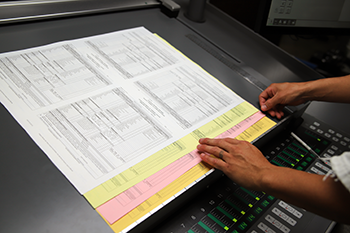
Lining up pages that will become a four-part form.
“Some of the machines require someone with a higher level of experience and sense of responsibility,” Ybarra said. “We select workers for these machines, because they are wanting to learn and do more, but safety is our highest concern.”
Like Ybarra, the staff at the Torres Print Shop find reward in their work. They are not here to just get things done; they’re here to serve as role models, to show what a good work ethic looks like and help shape and develop the inmates into dependable potential employees.
All of the work done here can result in jobs in the community. The software and applications in use in the presses and machines, and the organizational processes are all current with what outside companies are using. The inmates receive on-the-job training certificates and printed evaluations of their work along with help developing their resumés. Potential employers are encouraged to contact the print supervisors for references on inmates who are released and looking for meaningful work.