An employee publication of the Texas Department of Criminal Justice
Winter 2026
One Team, One Purpose
The Office of Strategic Initiatives & Modernization
Employees of the Texas Department of Criminal Justice (TDCJ) go to work and collaborate agencywide to keep the public safe. The Office of Strategic Initiatives and Modernization (OSIM) works behind the scenes daily to ensure the success of each of those people, including frontline staff.
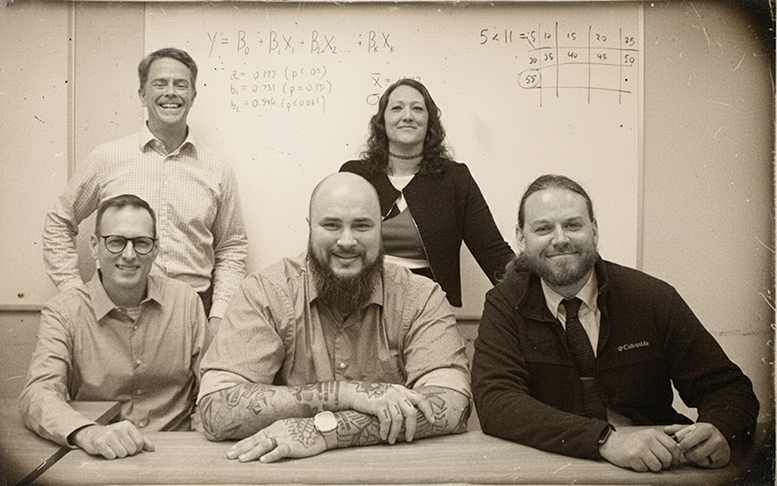
CISM is a new department in TDCJ made up of 25 employees who come to work every day with a shared purpose: to serve and enhance the agency’s experience. Their efforts range from improving internal processes to launching initiatives such as the Bartlett Innovation Unit. It is comprised of three different sections – traditional research, advanced data science and records retention, to help make new ideas a reality.
Two of the many integral jobs in OSIM are the roles of the director, Andrew Barbee and the data scientist, Frank Benton.
As the director of OSIM, Barbee uses his role to give a voice to employees of all ranks and positions across the agency and to positively disrupt established practices while challenging the “way we’ve always done it” mentality. He takes everything he hears and learns, then brings it back to leadership and his team to determine feasible changes that will improve the agency.
Trying to redefine how people work isn’t easy, but Barbee believes in the purpose.
“I’ve gotten my fair share of pushback when talking about the concept of revisiting how we do things to see if there is a better way. Much like Tom Brady does in the off season after his Super Bowl runs, as an agency we owe it to ourselves and the staff to look in the mirror and say, ‘I can still be better,’ even at the top of our game,” Barbee said.
An example that highlights the purpose of Barbee’s division is the Correctional Retention and Wellness (CReW) survey. The survey was developed to allow officers of all ranks to provide candid, anonymous feedback that is shared with leadership. It provides the right people with the opportunity to support accountability and growth within the agency. It also shines light on the areas where things are going great, allowing the agency to learn from the departments and locations where they are getting it right and improve across the state.
Two major changes that have occurred as a result of the survey are increased equipment purchases, including tasers and body cameras deployed to 23 maximum security facilities, and enhanced training for officers.
“The survey is illuminating needs and concerns for the agency. It has a tangible impact on TDCJ investment decisions, approaches to leadership development and improvement on how we hold people accountable,” Barbee said.
Another major focus in OSIM that impacts the entire agency is the effort to significantly decrease, if not eliminate, paper-based processes. Benton, an OSIM data scientist, is a driver of this goal. His role is to focus on keeping everything with the agency future-facing where things like reports, technology and processes can constantly evolve and be dynamic to capture information that the agency didn’t have before. This includes incorporating technology, where possible, to enhance efficiency of TDCJ processes.
“How many emails do you get per day where you’re like ‘this report again?’ or you’re constantly checking your email for a response with data that you need. My goal is to take technologies such as Power BI and other dashboard systems and use them to automate manual reports, so you have real-time access to pull the data or grab a graph without having to wait,” Benton said.
Significant changes in an organization like TDCJ can be nerve-wracking so it is no surprise that one of the biggest challenges in Benton’s role as a data scientist is also challenging the “it’s the way we’ve always done it” mindset.
One of Benton’s favorite parts of his job is that he gets to go out and talk in-person to the people that the decisions based on his data could impact.
“Going to units or visiting departments and understanding their struggle, then helping them overcome it is one of the best parts of my job. I like setting them up with current information to help them do their job efficiently and free them up to focus on their priorities,” Benton said.
Efficiency, transparency and experience are the themes of why OSIM is working to shake things up. They help leadership make well-informed, data-driven decisions for the overall success of the agency.
“OSIM is here to serve all divisions in TDCJ. We will always give our honest feedback and do everything in our power to directly aid in solving a problem or to give our best advice,” Barbee said.
If you have a process or a project that you need feedback on to make it efficient or effective, reach out to OSIM. They excel at developing simple, near-term solutions that are practical and, in many cases, won’t need money or vendor support.
“We are here to help. That is what we do. The best ideas for the agency come from the field,” Barbee said.
One of the first significant tools developed by OSIM was a risk assessment for inmates likely to engage in self-harm. In 2021, the annual rate of attempted suicides was 192 per 100K inmates.
The self-harm risk tool, launched in March of 2021, flags inmates at risk of engaging in self-harm so that interventions could be delivered. The 2024 annual rate of attempted suicides was 72 per 100K inmates, a reduction of 63 percent.


 Two major changes that have occurred as a result of the survey are increased equipment purchases, including tasers and body cameras deployed to 23 maximum security facilities, and enhanced training for officers.